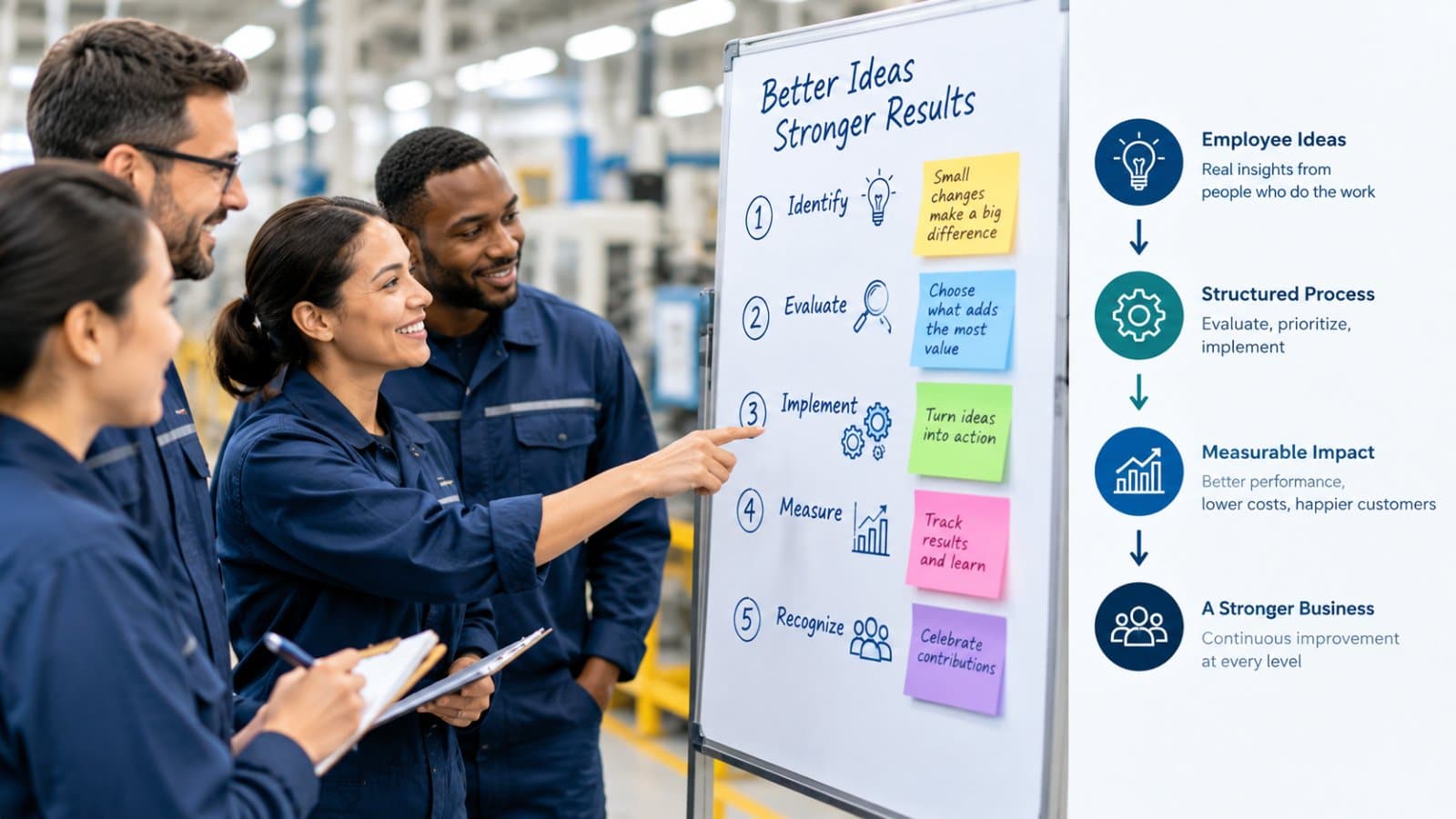
Your employees may already know how to improve your business. The question is whether your organization has a system to turn their ideas into results.
Imagine if every employee in your company could identify a problem, suggest a better way of doing the work, and help implement the solution.
Now imagine that happening hundreds or thousands of times a year.
Not through a major transformation project. Not through another management initiative. Through the everyday work of the people who know your business best.
This isn't just a management theory. Toyota has spent decades building a system around this principle.
And its experience offers an important lesson for every growing business.
Toyota turned employee ideas into a structured improvement system
Toyota launched its Creative Idea Suggestion System in 1951. The objective was straightforward: encourage employees to contribute ideas that improve the way work gets done.
The system grew substantially over the decades.
According to Toyota's own historical reporting, the company received more than 250,000 suggestions in 1973 from approximately 43,000 employees, with more than 70% expected to be adopted. By 2023, Toyota's Creative Idea Suggestion System had accumulated approximately 50 million suggestions, with around 810,000 submitted that year.
These figures describe suggestions submitted, not 50 million independently verified improvements. But the scale is remarkable.
Toyota's approach is part of a broader philosophy known as kaizen, or continuous improvement, built around the idea that improvement should involve people throughout the organization, not only specialists or senior management.
Sources: Toyota's 1973 report on its suggestion program and Toyota Times' account of the Creative Idea Suggestion System.
The important question isn't how many ideas Toyota collected.
It's how Toyota created the conditions for people to keep contributing, and for those ideas to be evaluated, implemented and recognized.
1. The people closest to the work often see the problems first
A CEO sees the overall business. Department managers see their functions. Employees see what happens every day when the plan meets reality.
They know where unnecessary steps consume time, where information gets lost, where equipment creates recurring problems, where approvals delay decisions, and where teams repeatedly do work that adds little value.
Yet many organizations rely almost entirely on management to identify problems and design solutions.
That leaves an enormous source of practical knowledge underused.
An employee might see a way to save ten minutes on a recurring task. Another might identify a recurring quality issue. A third might discover a simple way for two departments to coordinate their work more effectively.
Individually, these improvements may appear small. Across a team, repeated every day, they can have a meaningful cumulative effect.
The lesson for business leaders is simple: you don't need every employee to think like a CEO. You need to make it possible for every employee to improve the work they understand.
2. Asking for ideas is not enough. You need a process.
Many companies have an open-door policy. Managers tell employees to speak up, challenge the status quo and suggest improvements.
But what happens next?
Who evaluates the idea? Who decides whether it is worth pursuing? Who has the authority to approve it? Who provides the resources? Who implements it? And how does anyone know whether it actually improved the result?
Without clear answers, even good ideas can disappear into a suggestion box, an email thread or a meeting nobody remembers.
A working improvement system needs a repeatable process:
Identify → Evaluate → Prioritize → Implement → Measure → Recognize
Each stage needs a clear owner and a defined way to move forward.
Not every suggestion should be implemented. Some will be impractical, too costly or inconsistent with company priorities. Others may require testing before a wider rollout.
The point is not to say yes to everything.
The point is to ensure that good ideas receive a fair assessment, decisions are made, and approved improvements don't stall because nobody owns the next step.
3. Connect improvements to business priorities
Employee initiative creates value when it helps the business achieve something that matters.
A company may want to improve customer response times, reduce rework, increase productivity, strengthen safety, improve delivery reliability or reduce operating costs.
These priorities provide direction for improvement.
For example, imagine a growing company struggling with late customer deliveries.
Instead of telling every department to work harder, leadership could invite teams to identify the obstacles causing delays.
One team might propose improving the handover between sales and operations. Another might simplify order approvals. A third might identify a recurring scheduling issue.
Each proposal can be evaluated against the same questions:
What problem are we trying to solve?
How does this support our business priorities?
What improvement do we expect?
Who will own implementation?
How will we measure the result?
Now employees aren't simply generating ideas. They are helping execute the company's strategy.
4. Healthy competition can accelerate improvement, but it needs the right rules
This connects to another powerful principle: healthy competition.
Teams can challenge one another to find better ways of working. One department might develop an approach that reduces processing time, while another discovers a better method for preventing errors.
Sharing these successes can encourage others to learn, experiment and improve.
But competition must support the company's overall objectives.
If teams are rewarded only for their own numbers, they may optimize their department at the expense of the wider business. They may protect information, duplicate work or avoid helping other teams.
That isn't productive competition. It's organizational friction.
A better system combines three elements:
Shared goals: Everyone understands what the business is trying to achieve.
Team ownership: Teams have the authority and accountability to improve their work.
Fair recognition: Contributions and measurable improvements are acknowledged without undermining collaboration.
The objective isn't to create winners and losers inside the company.
It's to create an environment where teams challenge themselves to improve while helping the entire organization perform better.
5. Measure results, not the number of ideas
A high number of suggestions can indicate participation. It doesn't automatically prove that the business is improving.
Leaders need to distinguish between activity and outcomes.
Useful measures might include:
Percentage of approved ideas implemented
Time from proposal to decision
Time from approval to implementation
Reduction in defects, rework or delays
Time saved or costs avoided
Improvement in customer outcomes
Number of successful improvements adopted by other teams
Choose measures that reflect the company's priorities and the type of improvement being pursued.
Also, recognize that not every valuable contribution produces immediate financial savings. An improvement that makes work safer, prevents a future problem or makes a process more reliable can be valuable even when the financial return is difficult to calculate.
The purpose of measurement is to learn what works, make the value visible and guide the next improvement.
6. What does this mean for a company with 20, 50 or 200 employees?
You don't need Toyota's scale to apply the underlying principles.
In fact, a growing company may be able to introduce a practical improvement process without creating a new department or adding layers of management.
Start small.
Step 1: Choose a meaningful business priority.
Identify one problem that is affecting performance. Make the desired outcome clear.
Step 2: Invite the people closest to the work to contribute.
Give employees a practical way to identify problems and propose solutions. Make it easy to participate.
Step 3: Assign ownership.
Every approved initiative needs someone responsible for moving it forward, with the authority and support to act.
Step 4: Review progress regularly.
Create a simple rhythm for reviewing proposals, making decisions, removing obstacles and checking implementation.
Step 5: Measure and recognize the contribution.
Share what changed, what was learned and what value was created. Recognize the people who helped make it happen.
Step 6: Repeat and improve the process.
Use the lessons from one cycle to make the next one more effective.
The system doesn't need to be complicated. But it does need to be consistent.
The real lesson: build a business that can improve itself
Toyota's experience demonstrates what becomes possible when employee-driven improvement is treated as an ongoing organizational capability rather than an occasional initiative.
The principle applies far beyond manufacturing.
A growing business doesn't need thousands of employees to benefit. It needs people who understand the direction, the freedom to identify better ways of working, clear ownership for implementation, visibility into results and a culture that recognizes meaningful contributions.
Without that structure, improvement depends on individual enthusiasm and the occasional manager who pushes an idea through.
With it, improvement becomes part of how the business operates.
And there is an additional benefit for founders and CEOs.
When employees can solve problems, make decisions within clear boundaries and improve their own processes, fewer routine issues need to escalate to the top. Leadership gains more capacity to focus on strategy, customers and growth.
That is what a good operating system should do: not add bureaucracy, but make it easier for people to contribute and for the business to execute.
At Ascending, this is one of the principles behind our work with growing companies. We help business leaders establish the structure, ownership, visibility and execution discipline needed to turn business priorities into coordinated action.
Your employees may already have ideas that could make your company better.
The question is: does your business have a system that allows those ideas to become results?
If you're a founder or CEO who wants your team to contribute more, execute better and solve more problems without everything depending on you, let's talk.
Explore how Ascending helps growing businesses improve execution.